
Beginning the Journey: A Strategic Planning Process for the Diocese by The Rev Deacon Jessica Bickford (as published in Anglican Montreal September 2026)
/
Beginning the Journey: A Strategic Planning Process for the Diocese by The Rev Deacon Jessica Bickford (as published in Anglican Montreal September 2026)
When I was seven years old, my mother and I set off on a memorable adventure, travelling by train from Calgary to London, Ontario, where we met my uncle’s family before piling into their station wagon for the drive to Montreal to attend my aunt’s wedding.
It was a different era. Air conditioning meant keeping the windows rolled down, the latest hits played on the radio or eight-track player, and my cousin and I sat in the back of the station wagon to keep the peace. Tucked into the driver’s door was an essential travelling companion—the large yellow MapArt road map. It only appeared once, during a “stop for gas,” but that was enough. For the rest of the journey, my aunt happily reminded my uncle that she had known the correct route all along. To his credit, he accepted it with remarkable patience.
In many ways, the Diocese’s strategic planning process feels like that family road trip. Some travellers are eager to begin, excited about what lies ahead. Others approach the journey with questions or uncertainty, while some are simply ready to travel with the group. Regardless of where we find ourselves, we are setting out together. There will be unexpected turns, important conversations, and moments of disagreement. Yet when we arrive at our destination, we hope to celebrate a stronger, more connected diocesan family, better equipped for God’s mission.
The Journey Begins
Guiding this process is the Strategic Planning Committee, consisting of the Bishop, the Rev Jessica Bickford, Phil Castonguay, Fiona Crossling, the Rev Emmanuel St Hilaire, John Kirby and the Rev Debbie Noonan.
Since January, the committee has reviewed two decades of strategic planning archives, annual parish statistics, and planning models from other dioceses. With Bishop Victor-David’s participation and approval, the committee has developed a process that reflects both the realities we face today and the hopes we hold for the future.
A Grassroots Approach
Historically within the Diocese of Montreal, strategic planning has followed a somewhat top-down model, where representative groups provide input that committees analyze before presenting a final plan. While this approach has value, it does not always capture the full diversity of voices and experiences across the Diocese.
The 2026 Strategic Planning Process is recommending an approach that places parishes at the centre and broadens participation beyond formal representatives. The goal is to engage as many of the Diocese’s 5,464 stakeholders as possible—including clergy, parish leaders, parishioners, Synod staff, and ministry partners across five archdeaconries, eight deaneries, and 63 parishes.
By expanding participation, we create greater opportunities to listen, discern together, and remain attentive to the movement of the Holy Spirit as we seek God’s direction for the Diocese.
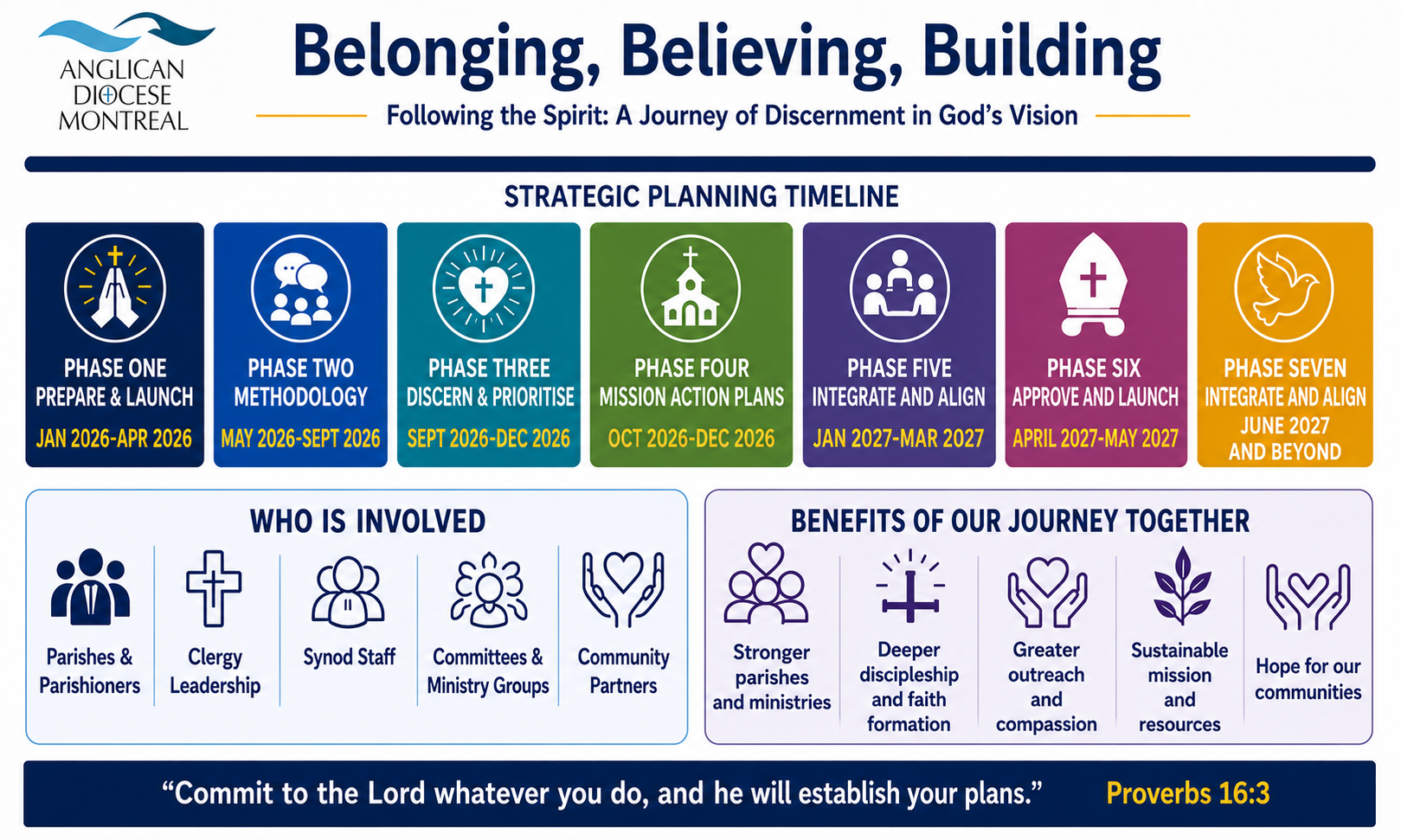
Phase One: Plotting a Course —Parish Mission Action Plans
Most people would agree that today’s Church looks different from the one many of us grew up in. Most churches are no longer at the centre of community life, and many parishes are experiencing fewer volunteers and limited financial resources. Yet these challenges provide an opportunity to rediscover what it means to be a vibrant spiritual community rooted in our neighbourhoods.
One question raised at the 2025 Diocesan Synod was: “How will parishes benefit from this strategic planning process?”
The first phase of the 2026 strategic planning process directly addresses this question. Every parish will receive a resource package designed to guide them in the creation of a Mission Action Plan (MAP). Rather than becoming another administrative task, the MAP is intended to help each parish prayerfully reflect on its identity, gifts, challenges, and future ministry.
Each parish resource package will include:
Parish data and key indicators;
Reflections on the parish’s relationship with God and the reasons members participate in its ministry;
Tools to identify mission, core values, ministry strengths, and partnerships;
A methodology for conducting a community resource inventory;
Resources for setting and evaluating future priorities and goals.
The committee recommends completing this work through a parish visioning day or a series of parish gatherings. Some parishes may already be engaged in strategic planning. The MAP process is intended to complement those efforts while ensuring consistent information is gathered across the Diocese.
By collecting Mission Action Plans from every parish, we will gain a clearer picture of the ministry and mission already taking place. This understanding will allow diocesan programs, resources, and structures to better support ministry at the grassroots level.
Listening to Parish Leaders, Clergy, and Staff
In Acts 20:28, Paul reminds the church: “Keep watch over yourselves and all the flock of which the Holy Spirit has made you overseers.” This passage highlights that leadership involves not only caring for others but also attending to the spiritual health and well-being of those who serve.
Recognizing the importance of healthy leadership, the Strategic Planning Committee has identified clergy, lay leaders, and Synod staff as key stakeholders in this process.
We will distribute surveys to each group to evaluate diocesan services, resources, communication, and support. This feedback will help identify strengths, areas for improvement, and the changing needs of ministry across the Diocese.
With respect to clergy, their survey will also include specific questions about professional development, ministerial needs, and pastoral support. Another area clergy will be involved in the strategic planning process will be at this year’s Clergy Conference. Time will be dedicated to prayer, reflection, and conversation around themes identified in the diocesan profile developed during the recent Episcopal election.
Finally, Synod staff will also be invited to participate in the process. Their experience provides a valuable perspective into diocesan ministries, emerging needs, future priorities, and the resources required to support ministry throughout the Diocese.
Together, these conversations will provide a clearer understanding of the health, capacity, and future needs of diocesan leadership. By listening to those who support and lead ministry, the committee hopes to strengthen leadership structures and ensure those called to serve are equipped, supported, and sustained.
Phase Two: All Aboard Discerning the Way Forward Together
Following the first phase of consultation, the Strategic Planning Committee will review the feedback and prepare a draft diocesan strategic plan. This draft will then be shared throughout the Diocese for prayerful reflection and consideration.
Deaneries will be invited to organize chapter meetings where participants engage in facilitated conversations about the draft plan. At this time, the results of the Mission Action Plans will be shared, allowing neighbouring parishes to offer feedback, identify shared priorities, and explore possibilities for collaboration.
These deanery meetings are an essential step in ensuring that the final strategic plan reflects the collective wisdom, experiences, and hopes of the Diocese. The process moves beyond consultation toward shared ownership.
Phase Three: Arriving at the Destination
Based on the information gathered at these meetings, the Strategic Planning Committee will prepare the final edition of the plan. We will then present the final draft to Diocesan Council in May 2027 and to Diocesan Synod in June 2027 for approval.
The Strategic Planning Committee intends for this process to build trust and strengthen ministry throughout the diocese. This process is like the creation of a symphony. Each parish, ministry, leader, and member contributes a unique note shaped by their gifts, calling, and experiences. The role of the Strategic Planning Committee is to listen, discern, and help bring these voices together into a shared understanding of God’s calling.
Together, we are not simply preserving the music we have inherited. We are discovering the new song God is inviting us to sing.
The Mission Action Plans, surveys, and consultations will provide a reflection of the Diocese—capturing the voices, gifts, experiences, and hopes of those who share in its ministry. Through intentional listening, collaboration, and prayerful discernment, we seek to create a strategic plan that is not written for the Diocese, but with the Diocese: one rooted in our mission, responsive to today’s realities, and guided by the Holy Spirit.