Learn about the new Anti-Black Racism Task Force in the Diocese of Montreal by Edward Yankie

Learn about the new Anti-Black Racism Task Force in the Diocese of Montreal by Edward Yankie (published in the Anglican Montreal March 2021)

(Edward Yankie is a member of Christ Church Cathedral and, along with Dion Lewis, the co-chair of the Diocesan Anti-Racism Task Force)

Sometimes history reaches a breaking point, and something like A Way of Transformation takes place because things can't go on like before. In addition to other uproars, including a pandemic, there is now such a breaking point—a saturation of too much bloodshed of Black people. Too many people who know the weight of oppression and can't breathe because they have knees on their necks. Along with this comes a great deal of denial, apathy, self-righteousness, and blindness in Canada and Quebec regarding our own history of slavery, racial oppression, and violence. No systemic racism in Quebec? (OK!) Say what you want against the idea of being woke, but in the face of a statement such as this, wokeness can't be all bad.

In response to this other ugly pandemic of denial (an obvious sin of wilful blindness as Covid continues to lay our structural inequalities bare), Christ Church Cathedral hung a Black Lives Matter banner facing Saint Catherine Street. As statements go, it's pretty basic. You could even call it humble. But many white people still can't bring themselves to say it without a qualification. And hate groups still want to tear it down and burn it. Yes, here in Canada too.

The banner was certainly not intended as an announcement that we, as a religious community, had arrived at our perfect utopia. It is generally recognized that we - especially those of us who are not Black - have to try to live up to it. To see more--to listen, understand, and support more.

In the midst of this growing awareness, a number of people from various churches within the diocese all came up with the same idea at pretty much the same time: What if we were to address anti-Black racism on a diocesan level? How would we go about doing that? How could we make things better in our diocese, in our city, our province, and in the wider world?

So, we reached out to folks, both clergy and laity, to form a group from all over the diocese, and met regularly to share stories, voice ideas, and figure out the best way to present our ideas to Synod. Much time and effort was put into this, and our hearts were a hundred percent involved, especially as the stories began to flow.

The Rev Deborah Meister devoted a tireless energy to our group, and, with the help of the Rev Deborah Noonan-Zink, worked to bring us all together. Dean Bertrand Olivier met with us and gave support, though he was recovering from surgery from a nasty bike accident. Bishop Mary also listened with her whole being, and gave kind and encouraging words. But people in our group with more experience than I still worried that the motion to create Diocesan Anti-Black Racism Task Force would not pass at Synod, and no doubt with good reason.

Fast forward to Synod, when the reverend James Pratt, Dion Lewis, and Camille Isaacs-Morell spoke powerfully and convincingly and the members voted overwhelmingly to approve the creation of the Task Force. There was much rejoicing. Dion and his partner Chris Grocholski hugged each other with an instantaneous, passionate embrace. Private messages were passed among the group that said: “Yes!” “Hallelujah!” “Thanks be to God!” It's no exaggeration to say that the Spirit descended upon

all of us. We exhaled deep sighs of joy and relief that our time and effort had not been in vain.

Now, of course, as 2021 continues with all its challenges, hardships, promise, and drama, we are brainstorming our next moves, and rolling up our sleeves, literally and metaphorically, to get to work. An old Zen saying comes to mind. “After the ecstatic experience comes needing to do the laundry.”

The task force is still being assembled, and is growing. Most of the original group are still involved, though new faces and names are showing up, for which we are grateful. We are still a mix of Black and White, Canadian born and immigrant, English and French, which, for the work we have to do, is important.

A survey has gone out to all the church leaders to determine where we are on this issue as a diocese, what people are thinking, feeling, and doing. And workshops are being planned, so that we can figure out how to be on the same page as a diocese.

Following the advice of Socrates, we are hoping to understand together and agree on what systemic racism is before we begin to have a dialogue about it and work on the problem. History will be discussed. Definitions will hopefully be agreed upon. And training for church leaders, and for the laity, and for all who wish it, will ensue. This is just the beginning.

Many people still think that racism is simply about having bigoted feelings, or being prejudiced against dark skin or otherness. But we often don't see or understand how deeply inequality is forged into the very fabric and make-up of our society. So there is still a lack of understanding for the need for systemic change. To cite a solitary glaring example of injustice, many families within the Haitian community are being separated, even children from their parents, by deportation practices that are nothing short of cruel. This we need to look into, and not away from. As James Baldwin said,

Nothing can be changed until it is faced.

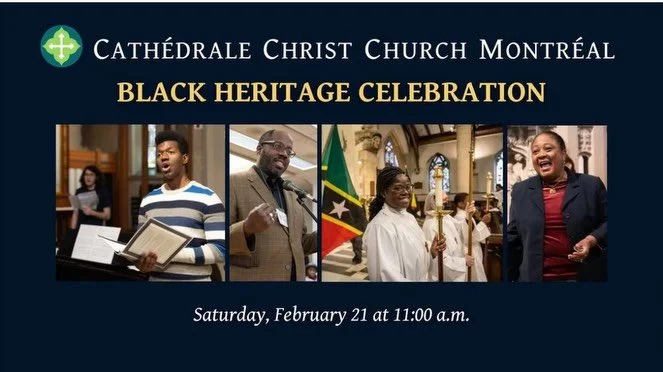
Meanwhile, a bilingual, diocese-wide Black History Month Celebration has been planned for the final weekend of February by members of the task force and others, including Bishop Mary and Dean Bertrand. It will certainly be, among other things, a celebration of love and thanksgiving for Black diversity and excellence within our diocese.

And so we launch into our new year, as lent approaches quickly, into challenge, celebration, and promise.

If you are interested in joining the Task Force, write us at Antiracism@montreal.anglican.ca.

Anchored in Hope / Ancrés dans l’espoir! (Bishop Mary Irwin-Gibson)

The Bishop’s Anglican Montreal Message Lent 2021

IMG_7502 2.jpg

Anchored in hope!

Our Diocesan coat of arms was created in 1850 when the Diocese of Montreal was formed out of the Diocese of Quebec. Over my front door is a stained-glass image of the arms, given to me by a friend when I became your bishop. Designed by Bishop Francis Fulford, first bishop of Montreal, it contains a pastoral staff, a key pointing up and outwards, an open book, a six pointed star, and an anchor – all heraldic symbols. The anchor relates to Montreal being a port city but it is also a symbol of faith and hope.

The original heraldic design shows an anchor with a rope. It’s the usual 19th century symbol for “hope”. Anchors are used to keep a ship in place during a storm and to keep them safe once safely moored. My mother used to sing the hymn “Will your anchor hold in the storms of life”. As a young person, I never gave much thought to what exactly the anchor meant except something to help a believer in tough times. The letter to the Hebrews says “We have this hope, a sure and steadfast anchor of the soul”. (6:19) This last year has been a stormy one for sure, filled with uncertainty and suffering and fear. The letter to the Romans speaks about how suffering is part of life and it can toughen us up and point us to hope for God’s plans and purposes: “And not only that, but we also boast in our sufferings, knowing that suffering produces endurance, and endurance produces character, and character produces hope, and hope does not disappoint us, because God’s love has been poured into our hearts through the Holy Spirit that has been given to us.” Romans 5:3-5 “Rejoice in hope, be patient in suffering, persevere in prayer.” Romans 12:12 What has been anchoring you in this last stormy year?

What has been your spiritual lifeline? I’m sure that there have been times when you did not know what was coming next and you were very worried. No one likes suffering and no one likes being worried and afraid. And yet, our faith tells us to hold on and to trust that God is bigger than what we are going through. And that God is with us always. Because of the power of God’s love, we can lean hopefully into what is ahead. While many of us may have grown as disciples through this time, I want to assure you that no one has all the answers to the questions of faith. The letter to the Corinthians encourages us: “We don’t yet see things clearly. We’re squinting in a fog, peering through a mist. But it won’t be long before the weather clears and the sun shines bright! We’ll see it all then, see it all as clearly as God sees us, knowing him directly just as he knows us! But for right now, until that completeness, we have three things to do to lead us toward that consummation: Trust steadily in God, hope unswervingly, love extravagantly. And the best of the three is love. ⚓ ” 1 Corinthians 13: 12-13, The Message “May the God of hope fill you with all joy and peace in believing, so that you may abound in hope by the power of the Holy Spirit.” Romans 15:13

Message de l'évêque Carême 2021

Ancrés dans l’espoir!

Nos armoiries diocésaines ont été créées en 1850 lorsque le diocèse de Montréal a été formé à partir du diocèse de Québec. Au-dessus de ma porte d'entrée, se trouve un vitrail des armoiries qui m'a été donné par un ami lorsque je suis devenue votre évêque. Conçu par Mgr Francis Fulford, premier évêque de Montréal, il contient une crosse, une clé pointant vers le haut et vers l'extérieur, un livre ouvert, une étoile à six raies et une ancre - tous des symboles héraldiques. L'ancre rappelle que Montréal est une ville portuaire, mais elle est aussi un symbole de foi et d'espoir.

Le dessin héraldique original montre une ancre avec une gumène (câble). C'est le symbole habituel du XIXe siècle pour "l'espoir". Les ancres sont utilisées pour maintenir un navire en place pendant une tempête et pour le garder en sécurité une fois amarré. Ma mère avait l'habitude de chanter l'hymne «Will your anchor hold in the storms of life». Dans ma jeunesse, je n'ai jamais vraiment réfléchi à la signification exacte de cette ancre, si ce n'est pour aider un croyant dans les moments difficiles. La lettre aux Hébreux dit :

Cette espérance, nous la tenons comme une ancre sûre et solide pour l’âme (Héb.6, 19a)

L'année dernière a été une année orageuse à coup sûr, remplie d'incertitudes, de souffrances et de craintes. La lettre aux Romains explique que la souffrance fait partie de la vie et qu'elle peut nous endurcir et nous inciter à avoir confiance dans les plans et les desseins de Dieu :

Bien plus, nous mettons notre fierté dans la détresse elle-même, puisque la détresse, nous le savons, produit la persévérance ; la persévérance produit la vertu éprouvée ; la vertu éprouvée produit l’espérance ; et l’espérance ne déçoit pas, puisque l’amour de Dieu a été répandu dans nos cœurs par l’Esprit Saint qui nous a été donné. (Rom. 5, 3-5)

Ayez la joie de l’espérance, tenez bon dans l’épreuve, soyez assidus à la prière. (Rom. 12,12)

Qu'est-ce qui vous a ancré au cours de cette dernière année de tempête ? Quelle a été votre ligne de vie spirituelle ? Je suis sûre qu'il y a eu des moments où vous ne saviez pas ce qui allait arriver et où vous étiez très inquiets. Personne n'aime souffrir et personne n'aime être inquiet et avoir peur. Et pourtant, notre foi nous dit de nous accrocher et de croire que Dieu est plus grand que ce que nous vivons, et que Dieu est toujours avec nous. Grâce à la puissance de l'amour de Dieu, nous pouvons anticiper avec espoir sur ce qui nous attend.

Même si beaucoup d'entre nous ont grandi dans leur rôle de disciples au cours de cette période, je tiens à vous rappeler que personne n'a toutes les réponses aux questions de la foi. La lettre aux Corinthiens nous donne courage :

Nous voyons actuellement de manière confuse, comme dans un miroir ; ce jour-là, nous verrons face à face. Actuellement, ma connaissance est partielle ; ce jour-là, je connaîtrai parfaitement, comme j’ai été connu. Ce qui demeure aujourd’hui, c’est la foi, l’espérance et la charité ; mais la plus grande des trois, c’est la charité. (1 Cor. 13, 12-13)

Mes prières vous accompagnent :

Que le Dieu de l’espérance vous remplisse de toute joie et de paix dans la foi,
afin que vous débordiez d’espérance par la puissance de l’Esprit Saint. (Rom. 15,13)

The March Edition of the Anglican Montreal is HERE

As we reach the grim anniversary of our collective Covid 19 journey, many of us have been reflecting on this remarkable year and lessons learned. After compiling and editing stories for the latest issue of the Anglican, I am happy to report that the common themes emerging from our trial are those of hope, inspiration and new beginnings. I encourage you to read the paper, online or in print, and as Bishop Mary quoted Romans 12:12 in her message: "Rejoice in hope, be patient in suffering, persevere in prayer."

Screen Shot 2021-02-22 at 1.12.18 PM.png

Deacons are Going Digital!

Our Deacons are going Digital!

  • They have a new bilingual logo

  • They have a new page on our website (click here)

Stay tuned as they are about to launch on social media!

final.png
french final.png

“The ministry of Jesus Christ is one of servanthood. All baptised followers of Christ, according to their gifts, are called to participate in this ministry of servanthood, within the Church and in the world. Deacons, then, are icons of servant ministry: while servant ministry is the calling of the whole people of God, some members of the Church are called to the specific order of the diaconate as models of this ministry.”

You are invited to a Unique Digital Celebration of Black History with Christ Church Cathedral and the Diocese of Montreal!

10.png

Vous êtes invitées à une célébration numérique unique de l'histoire des Noirs avec la cathédrale Christ Church et le Diocèse de Montréal !


You are invited to a unique digital celebration of Black History with Christ Church Cathedral and the Diocese of Montreal!

Contact Bertrand Olivier for more info

https://zoom.us/j/92678992180?pwd=SEtRaGI2eXBZekhBSTA4bE85MURqQT09

Webinar ID: 926 7899 2180
Passcode: 1857

Blog: The Journey of Grief by Neil Mancor

The Journey of Grief

The last year has been a journey through fear, uncertainty to boredom, then more fear and uncertainty perhaps to resignation. As COVID-19 has failed to disappear on command but has proven a rather more relentless foe than we expected our lives have been turned upside down. Along with that may come another word that is hard to say and sometimes harder to embrace: grief.

The losses we have suffered are multiple and ongoing. Some of us have suffered the loss of people we have known and loved in circumstances far from normal, without the ability to visit, to touch, to be together one last time. Others of us have been touched more distantly by loss – someone in my wider friendship circle was taken by COVID-19.  It was a shock that brought uncomfortable truth closer to home. But then there have been other losses to bear. We have lost the freedom to go about our daily lives without fear. In Church, we have lost the freedom to be together as we have been able to do all our lives. Like everyone else, I have never known a time when Churches were closed to worship, and certainly not for an extended period of time. I miss being with everyone. Even more, I grieve the life we once had but may not have again in quite the same way.

Those losses are real and so is the experience of grief. But sometimes the characteristics of grief within us are unfamiliar and unexpected. That is one of the reasons why as a Diocesan family together with the parish of St Mark’s & St Peters we are offering the GriefShare programme, starting Thursday February 4th We are doing this because acknowledging our losses and our grief is the pathway to growing through them. Grief is not a journey we need to take alone: we can travel along that road together in a safe, supportive environment. It is not an easy journey, nor is there a way to fast-track through it. But it is a journey we can travel through with God and with one another. And that helps us bear the load a little easier.

For more information contact me: nmancor@montreal.anglican.ca. Just remember: you are not alone.

Honoring the Black Community for Black History Month 2021

Originally published in the September 2020 edition of the Anglican Montreal

by Juliet Oppong-Nuako

Black Lives Matter.  

This statement incites many emotions, some confusion and some misconceptions. What exactly does it mean? Simply, that there is value in black lives. There is value in lives that have been denigrated for generations by the legacy of slavery and racism. Yet, you may ask, why are black people screaming this message now? Why must we voice this simple message that should - after all this time - be self-evident? Because still, even in the 21st Century, we are told, even if implicitly, that our lives have less value through oppressive systems that put whiteness at the forefront. We are told we are inferior with stereotypes and perceptions that continue to denigrate black people to this day. 

In July of 2013, Black Lives Matter began as a twitter hashtash following the acquittal of George Zimmerman, who shot and killed Treyvon Martin in February of 2012.  In subsequent years, more deaths of black people followed at the hands of the police. Recently, the death of George Floyd on camera led to a special awakening for many. George Floyd was killed by Derek Chauvin, a Minneapolis police officer. His death led to an awakening for many because it brought again the issue of racism to the forefront of everyday conversation. Protests for BLM spread far and wide. This was pivotal and necessary to the cause.

My own awakening began in 2015, when I was introduced to the phenomenal powerhouse that is Shanice Nicole, a Montreal-based educator, speaker and poet. Back then, Shanice made me uncomfortable. This outspoken black woman was talking about how we should push against the systems that continue to oppress black people. She made me uncomfortable because I remember having deep-seeded convictions and distrust for my own colour. How was I to reconcile all these emotions? 

Shanice made me remember how I told a black friend of mine, “I wish I was white so I could have the long blond hair like the white girls.” She brought to mind my parents constantly preparing me to assimilate to the white culture, by telling us such things as, “Your skin colour will always stand out, so you have to learn to conform. You have to excel. You have to be educated. You have to dress in a certain way.” Shanice made me feel emotions that I wanted to suppress. How could I go on assimilating if I confronted these emotions? In my mind, assimilation equalled greater opportunities in life, and I was not going to feel or do anything to jeopardize that! I was uncomfortable with what Shanice was offering but I understood that it meant something powerful.  

Shanice made me realize that no amount of academic credentials or successful assimilation to the Canadian culture would protect my black son from deep rooted prejudices that are held by many, subconscious or otherwise. My husband and I began “The Talk” with our son at the tender age of five. Every black parent has “The Talk” with their children. My parents had many talks about race with my siblings and me as we grew up.  Our “Talk” involved letting us know that in many situations, the colour of our skin will play a factor in how people treat us. “The Talk” involved warning us to always be respectful of authority (especially police officers), not just because respect is an important behaviour to cultivate but because disrespect of an authority figure might lead to us being apprehended, hurt, or killed. “The Talk” is heavy and is done gradually. But it must be done to keep our black children vigilant. To bring our black children safely home. Back in 2015, I started discussing Shanice’s views with the rest of my family, who being supportive, listened. Life, however, moved on and I returned to living my life the best that I could.  

On May 25th, 2020, George Floyd was killed, and my feelings resurfaced. The death of George Floyd coupled with the current crisis of COVID-19, has led us into a state of global unrest. This situation pushed me to engage in a great deal of reflection and introspection.  I was ready to confront my reality as a black woman. Shanice Nicole states, “We are all in this air, so how complicit are we?”. Are we examining our own actions, the conscious and the subconscious, towards black people and other people of colour? Are we bringing awareness to the social and economic injustices that we see daily? I am choosing to not be complicit anymore. To abandon comfort and to lean into what I had previously considered as uncomfortable territory.  

In the past few months, I have felt free to embrace the natural hair that grows from my scalp and the beautiful melanin that makes my skin glow. Standards of beauty have historically centred on strait hair and light skin. So, in a sense, I am returning to myself. This knowledge and appreciation of the black body has led to a deeper spiritual awakening within me, and the need to spread awareness so that black children can understand their worth and have the tools to let their natural value shine.

It is of the utmost importance to examine thoughts, words and actions towards black people and other people of colour. In the face of racism, we should call out those who continue to uphold racist belief systems that are detrimental to equal opportunity and equal access for black and marginalized lives. These systems continue to lead to the devaluing and the death of black people at the hands of those in authority who should protect us. Truly, for all lives to matter, black lives and all marginalized lives must matter. Black Lives Matter helps us live what Scripture has taught: “Do what is just and right. Rescue from the hand of the oppressor the one who has been robbed. Do no wrong or violence to the foreigner, the fatherless or the widow, and do not shed innocent blood in this place” (Jeremiah 22:3). 


New Blog from Neil Mancor: What does the Church have to do with Social Entrepreneurship? It’s all about relevance.

What does the Church have to do with Social Entrepreneurship? It’s all about relevance.

Neil Mancor (Congregational Development, Diocese of Montreal)

I can’t count the number of Church websites (mostly not Anglican) that say something like We aim to make our sermons relevant to everyday life. But then again I can’t count the number of Anglicans who complain that our liturgical tradition isn’t relevant anymore – as if putting on an ancient liturgy ever was relevant. My favourite was a missioner talking to me about setting up a student ministry at a local CEGEP and engaging with the students about the questions that are relevant to their lives, like evolution and creationism. Need I say more?

The problem I think is that we tend to think of relevance in terms of content. But true relevance for the Church now lies through connection. Churches that flourish particularly in the post-COVID world will be those deeply connected into their local communities. Churches that know the needs, sorrows, joy and aspirations of the people who live around them.

Imagine this: your church running a coffee shop, giving jobs & training to local young people. Or a carpentry business that is also an employment scheme. Or maybe setting up an affordable meal-kit programme. The possibilities are limitless if you allow your imagination to be met by the inspiration of the Holy Spirit.

One of the things we encourage all churches to do is to reach out into your local community to assess local needs and make partnerships with others who share your values. That will be different in different places. But wherever there are human beings gathered together you can be certain there are deep needs in every way. When was the last time you put on a community meal and got local people talking about their lives, aspirations and desires? 

But the next step may just be the development of a social enterprise based out of your church that addresses the very real needs of your community. A great example of this is Outflow, a ministry based in St John, NB. It began as a simple street food ministry and has developed into a shelter, a coffee shop, a construction & renovation business and more. The focus upon training is to help those who find it hard to get into work to gain the skills and experience necessary. Their focus is to look  for opportunities to reduce the unemployment, hunger, homelessness, and medical costs in St John.   It began a mere 10 years ago when two guys named Jayme and Phil listened to what they thought the Spirit was saying and started handing out sandwiches on the streets of St John. Since then they have repurposed abandoned Churches and buildings and built a ministry in partnership with many others.

The point is, that is what God called them to do in their community. The question is: what might the Holy Spirit be prompting you to do in yours? Start small, because small is great.  But churches that flourish will be those who take the time to figure out the needs all around them. And it might just be that creating a social enterprise that helps others will be the thing that brings to your ministry the truest relevance there is. Think about it. Check out: www.outflowsj.com

Watch the interview (Pew & Beyond) February 2nd / Facebook Live 2nd at 1pm EST

145429643_10157939506511367_884154861817772455_n.jpg